Showing posts with label adoption. Show all posts

Sunday, December 31, 2017

The adoptee and her DNA

This past summer Liam expressed interest in finding out more about his ancestral background, so we ordered 2 DNA testing kits - one for him and one for myself.  As the adoptees of the family, we felt this would be fun to do together; Hilary can trace her ancestry back pretty far, and when you see pictures of her with various relatives, there is little doubt that they are all genetically related.

Genetic connections have always fascinated me, probably because I grew up without any.  Seeing siblings that look alike, babies sporting great-aunt so and so's nose, and all the other observable traits in families have always been bittersweet for me.  I was taller, tanned more, had genetically impossible eye colour and different hair from my parents. I did have one cousin who everyone said I looked like, especially if you compared baby pictures of us.  That led to many adoption fueled fantasies about how we really were related but that there was a  big family secret that no one wanted to tell us about. (Spoiler alert: there wasn't)

I finally got a picture of my birth mother Iris and my half sister when I was in my 30's.  I poured over every pixel looking for a resemblance.  I was very disappointed to not find much.  Even Iris said that she didn't see any resemblance in us, but did offer up the nugget of information that she though I looked like I took after my father's side.  Unfortunately that was about as much information as she was willing to tell my about my birth father.

With the easy availability of DNA testing kits today, it seemed like a great idea as an adoptee to possibly fill in some missing information.  I knew the information would be quite generalized, a list of potential percentages from different areas of the world, but it was still more information than I had before.  What I didn't anticipate was some of the emotions that doing this would unearth.  When the kits first arrived in the mail it took me over a month just to be able to open it and read the instructions.  From there it took another couple of weeks to work my way up to actually registering the kit online, spitting into the little tube and mailing it in for analysis. Once it was mailed off I was able to bury the thoughts of it in an "out of sight, out of mind" kind of way.

Until the email came telling me that it was ready.

I had chosen to do our tests through Ancestry.com  Part of the decision was price, part was based on the other main stream test being geared more towards testing your DNA for potential medical issues and partly because Ancestry.com includes family tree software.  I knew going into this that one of the possible outcomes of having your DNA tested was being connected to someone who you were genetically related to that had also been tested.  The media has been full of stories of best friends finding out they are actually siblings and other adoption-reunion situations.  Of course in the deepest recess of my mind I held out a smidge of hope that I might become one of those stories.  I already knew that I have 5 half-siblings, and potentially any number of cousins, aunts or uncles.

I opened the email and started with my ethnicity estimates


No big surprises there.  Iris had given me some indication of where her family was from, so I fully expected Western European and British.

I very quickly moved on to the next section.


Here were real people, with pictures(!) that I was potentially related to. My closest match was a 1st cousin.  The Ancestry.com website has a message option that you can reach out to people that you have potential matches with so that you can connect and discover exactly how you may be related.  By this point I was all in, so I quickly put together an email about who I was and how we may be related and sent it off to 7 possible 1st cousins. 

Within hours I had heard back from someone.  I had enough identifying information about my birth family to confirm our connection.  Overall I have had contact with 3 of my cousins, one from my birth mother's side, and two from my birth father's.  

Since then I have had many emails back and forth, one phone call, been sent dozens of pictures (including a picture of my half-siblings on my father's side) and heard stories about my birth father and his family. I was also able to find out that my birth and adoption was not the well kept secret that Iris had thought it was.  Rumours and stories of my existence have made the rounds of all the family functions.

It has definitely been an emotional roller coaster, but I've learned over the years that most things associated with adoption are.  I'm so glad for the information and connections that I have from doing the DNA test, and it may open many other doors yet.


Tuesday, April 21, 2015

Ancestors

I have long struggled with the definition of "ancestor"

Webster's defines the word as "a person who was in someone's family in past times : one of the people from whom a person is descended".

As an adoptee this becomes a bit of a head scratcher. Are my adoptive parent's "people" my ancestors? They are my family. But so are my birth parents, and their people. Does ancestry imply a DNA connection? Or is it a weird bit of both?

There is a new show out (at least new to us) put on in part by Ancestry.com They help famous people research their ancestors and you get to follow along on their journey to find out if Great-times-8 Grandma was an axe murder or the local librarian. (Hint, in the episode we watched, she was an axe murderer!)

There seem to be 2 types of people doing the research. Group 1 finds out some trait about one of their ancestors and immediately decides that this is why they have that same trait. "I'm musical because I share 1/100th of my DNA with someone who sang in the church choir 300 years ago" or "I'm a strong believer in human rights because my great-great-great grandfather helped out with the Underground Railroad." Group 2 doesn't attribute their own successes/failures, likes or dislikes to their long dead kin, they just think it's cool to find out the history of people.

I find these shows uncomfortable to watch, mainly because of group 1. Knowing that my adoptive Great-Great-Great Grandparent did XY or Z really has no bearing on my ability to do the same thing. But I doubt it matters if my biological Great-Great-Great Grandparent could do it either. Do I get my sense of humour from genetics or being surrounded by funny people as I grew up? What makes me like animals, music, reading or anything else? Am I the product of my ancestors, or am I just only me?

When I was 11, I became very interested in tracing my adoptive family tree and spent a lot of time working on a big chart, filling it out from found obits and family stories. Since my adoption was during the closed-era, I had very limited information regarding my birth family and I figured I would never be able to find out anything about them. My interest with my adoptive family's history was very much an attempt to be able to connect with the past, any past. It felt important to me at the time to be able to say that these were my people and this is where I came from.

When I was 13 my mother, grandmother and I travelled to England to meet my grandmother's cousin. The trip was steeped in history, visiting gravesites and castle grounds where "our" ancestors had worked (we didn’t stumble across any long lost royalty, just a couple of gardeners). About halfway through the trip, I had a complete breakdown one night before bed. "I" had no ancestors. I didn't have any people that I came from. These stories and this history wasn't mine.

One of the few things that my birth mother sent me after we were reunited was 20+ pages of her family tree. She and her daughter that she raised had worked on it together for a school project long ago. She thought that I would like to see where I came from. It was a bitter sweet gift. Finally after 30+ years of not knowing where I came from, I was holding it all in my hands. But it didn’t mean anything to me. They were just names and dates on a piece of paper, with my name and birthdate penciled in like an afterthought. I realized that I had no connection to any of these people, even if we did share our genetic makeup.

It’s very difficult sometimes to feel like I belong and have a connection to the past. Other times it feels like my history starts with me, that there isn’t anything that came before me. I think I will follow the advice of Ralph Nader “We must strive to become good ancestors.”

Friday, May 30, 2014

Comments

People blog for all sorts of reason - a place to work through their stuff, to share what their family is doing with friends who are far away, to educate others, to promote their own business or to share their views on current events.  There is no right or wrong reason, or way to blog.  But one thing that most blogs have in common is comments.  Melissa from Stirrup Queens says it so well "commenting is the "Polo" to blogging's "Marco" (you can check out her full post here)

I love getting comments, so I make the effort to leave comments.  That's how it works in conversations, so why not in blogs.  You say something and I respond.  And like conversations, you and I may not always agree with what is being said.  For most grown ups, that can lead to great discussions or debates and can help to open up each other's understanding to a view point that is drastically different from their own.

For some grown ups though, it can lead to childish reactions.  "I don't agree with what you say, so I'm going-to stick my fingers in my ears and shout NANANANA-BOOP BOO till you go away".  It's rarer that you see this in real life conversations (though I have encountered it) but it happens a lot with blog comments.  It's all thanks to the wonderful MODERATE button.  Comments that need to be pro-actively approved before they can be seen by other people reading the blog.  It gives the blog writer the ability to pick and choose which comments they publish.  It's great if you have trolls or spammers.  It's not so great when people use it to censor ideas that do match their own.  It shuts down the opportunity for ongoing discussion and learning.  It limits their readers to only hearing one opinion on a subject.

I encountered this situation this week.  A group of adoptive parents where discussing a blog post that shared an adoption story.  The main point of this blog post was that the adoptive parents re-created a water birth situation with their newborn adoptee and had it captured in pictures.  All of the adoptive parents in the discussion agreed that this was odd, strange, unsettling and done by people who may not be well educated in adoption.

As an adoptive parent, but more so as an adoptee, I too had many thoughts and feelings on this blog post and the idea of re-creating a birth session.  So I left this comment:
The photos are stunning and beautiful and on their own they would be a wonderful way to celebrate any family. BUT..... 
I am both an adoptee and and adoptive mother. One thing that people often forget is that the cute little babies grow up. What seems like a wonderful idea through the rose coloured glasses of new adoptive parents, or the Hallmark version of adoption that people not connected to adoption believe, are not always wonderful ideas to people on the other side of the adoption triad. 
I love both the first pictures my parents have of me and the first pictures I have of my son. They celebrate the milestone of each of us joining our family. None of these pictures try to react the pieces and moments of our lives that do not belong with the families we now live with, but belonged to our first families. 
I showed these pictures to my (adopted) 11 year old son and explained what they were. His response was "that's kinda dumb, there's nothing wrong with adopting." And that is how these types of photos can make adoptees, like baby Sebastian who will one day grow up, feel - adoption must not be good enough for you if you needed to stage a pretend birth and bonding moment.

As soon as I saw "Your comments are awaiting moderation" pop-up, I knew that my comments would never make it on this blog.  The other comments all left there are telling the blogger/photographer how wonderful and beautiful this is.  Not a negative thought among them.

It's been 3 days now since I left my comments.  I'm drawn back to the post throughout the day to see if maybe, just maybe the will post my comments.  But I'm not holding my breath.

You can check out the post, and it's happy comments here:  Birth without fear

UPDATED JUNE 6, 2014 - I have just found out that my comments have indeed been published.  I'm glad that my voice and that of others has been heard.

Friday, May 17, 2013

Was or Am?


A few weeks ago I read a sentence on a blog that has stuck with me. Unfortunately I don’t recall who’s blog it was (an example that I might read a few too many blogs….)

Anyhoo…

The sentence was something like this:
 “I know children who are adopted and adults who were adopted”.
It caused me to pause…. 

Why is the semantics different for children and adults? At what age does adoption stop being a current/ongoing event to something that happened in the past?

My own semantics are completely opposite to the original posters. When I talk about myself, I will say “I am adopted”… an ongoing state of being, much like I refer to myself as being brunette. And yet, when I’m talking about Liam, I am more likely to say “he was adopted.” I hear myself doing it, and I’ve often wondered why?

Having thought about this sentence for the last week or so, I think the difference for me is that I have embraced adoption as a part of me. It has shaped the person I have become. And yet, I’m not quite ready to use it to define Liam. Perhaps my view is skewed as I’m the parent in his case, and I do see his adoption as something that happened on a specific day. He may one day see himself also defined by the fact that he was/is adopted and then he too may say “I am adopted”.

Which version do you use? Does the persons age factor into your choice of words?

Thursday, May 16, 2013

Blog Hop #4

Heather over at Open Adoption Bloggers  is hosting another Blog Hop in order to help connect people to new (and old) bloggers.

 The question everyone has been asked to answer is:

"What was the last book you read??"

I love to read!  My problem is that I have very little time to sit down and read a book.  When I find a book that I really enjoy, I will lose myself in it till I finish it, personal hygiene and employment be damned.  The Harry Potter series, Twilight and the Hunger Games trilogy were all like that for me.  I read the Hunger Games from cover to cover on boxing day and was in line when the stores opened the next morning to buy the next 2 books.

Alas, I can't devote that much time to reading very often.  I have found a solution though!  Audio books!  Load it up on my I-pod, put it in my arm band and I can listen to my book any time, any where. And now that I've figured out how to borrow them for free from the library, I'm all set!

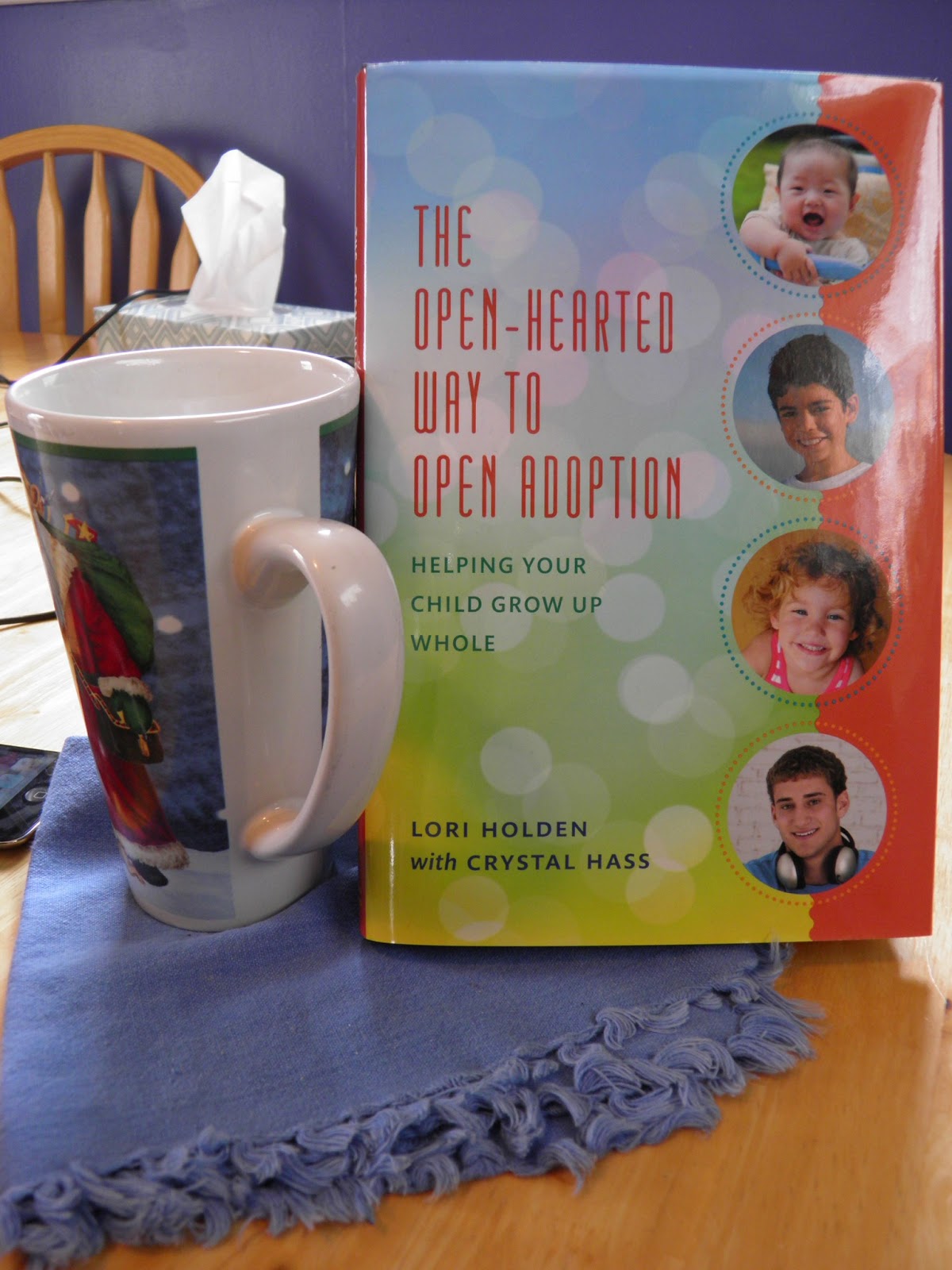
So now to answer the question...What was the last book you read?  The last paper book I read was The Open Hearted Way to Open Adoption written by my friend Lori.  The last audio book I've listened to was The Affair by Lee Child.    My mom introduced me to this series last summer and I really enjoy them.

So, what was the last book you read?

Thursday, May 9, 2013

Open Hearted Adoption - Book Tour

Click HERE to buy the book on Amazon.

My friend Lori recently wrote a book AND got it published! I'm so very proud of her.  She even quoted one of my blog posts in her book.  Now we are doing a virtual book tour where bloggers who have read the book answer different questions put forth by other bloggers.  A big shout out and Thank you! to Melissa from Stirrup Queens for organizing things and keeping us on track.   Be sure to follow the link through at the end so that you can read everyone else's post.


1. The term “Real Mother” or “Real Parents” comes up quite frequently in an adoptee’s life. Lori suggests in her book that we see each set of parents (birth and adoptive) as “Real”. Do you agree? How would you personally handle this terminology? And are there other ways to effectively deal with this term if used by your child or directed at your child by another?

a. As both an adoptee and an adoptive mother, I very much agree that all of a child’s parents are REAL. As a child it really bothered me when people asked about my “real” mother, especially if my {adoptive} mother was there. The guilt !!

Now as an adoptive parent myself, I’m not personally offended if someone refers to my child’s mother as his “real” mother, but it is an area that I often feel compelled to correct people from outside the adoption circle when they use it.

 My child has tried to use the term “real” mother during a disagreement…. “My REAL mother wouldn’t make me clean my room”. Umm.. sorry buddy, but I’m pretty sure she would. I’ll be sure to ask her next time I send her an email….. the joys of open adoption!

2. My question concerns openness and pre-birth matching, which Lori covers in Ch. 1 (citing Luna's early match with her daughter's birth mother, at pg 20-21) and Ch. 7 (discussing the balance between hopeful adoptive parents feeling cautious and joyful when an expectant mother could still decide to parent, at pg 134-36). Pre-birth matching is common in open adoption. Some might argue that, due to the potential for even subtle manipulation with expectations on both sides, pre-birth matching is inherently coercive. Others suggest that pre-birth matching provides a chance to build a relationship and foundation for real openness after placement. 

Since both sides seem to have the child's interest at heart, what steps, if any, can be taken to ensure that expectant parents aren't pressured into placement in the name of openness AND have an opportunity to get to know the prospective parents, which may help inform their ultimate decision?

a. This is such a tough question. We had a pre-birth match with my son’s mother, long before I knew what to call it, or had ever heard of it being potentially coercive. I now look back and worry about whether or not Liam’s Mom felt coerced or manipulated. Did I do or say anything that caused her to make a decision that she would not have done otherwise? However, I also treasure the time that we got to know her and can share some of those moments with Liam. I feel much more connected to her then I think I would have otherwise. We had the opportunity to discuss parenting styles, outlooks on different topics and ideologies. I feel much more confident in my parenting choices knowing the little bit about her parenting choices that we were able to learn in those pre-birth days. I  hope that she was also able to take some comfort from getting to know us as well.

The rules here in Nova Scotia are much different then what I read about from American friends, but I still believe the underlying subtle manipulation and coercion can still happen. One of the steps that I think must be taken is that the expectant parents MUST have independent support from an adoption professional. Since adoption is not a for-profit industry where I live, that adoption professional can come from the adoption agency. However, in the USA and other areas where the adoption agency profits from adoption, I think that the support for the expectant parents should come from an independent outside source. This will give the expectant parents an unbiased person to talk to, share their fears with and have someone in their corner, helping them explore all possibilities – especially the choice to parent.

Of course the million dollar question is "Who pays for this unbiased professional?"  Short of removing money from the adoption equation completely (and using a model similar to what we have here) I don't have an answer for that.


 Please return to the main post to read more opinions on Lori Holden's The Open-Hearted Way to Open Adoption.

Wednesday, February 27, 2013

I've decided to search!

I'll be adding my picture to all the others currently on Facebook.  No idea if this will bring any results,  but nothing ventured, nothing gained!

Thursday, February 21, 2013

Should I?

My Facebook feed has lately been clogged with pictures of adoptees (or birthparents, or siblings) holding up posters with their information, trying to find their first families.  Social media is a huge part of our lives today, and a picture shared with a few friends can suddenly go viral.  The number of people who have been reunited through this method is growing.  There is a whole Facebook page dedicated to helping people share their pictures.

Every time I see one of these pictures go by, I think "Should I?"  Should I print up what information I know about my paternal half-siblings and put it out there for the fates to handle? I have enough bits and pieces that someone might make the connection.  I have met my birthmother and I look nothing like her or her other daughter.  I suspect that I do look like my paternal half-siblings, based on the bits and pieces I have.  Would someone see the picture and make the connection?

The pros and cons are overwhelming.   Do I want to find them?  What if I don't find them?  If I found them, how would it affect Iris?  Should that concern stop me?  What will I find?  Do they know about me and don't want to be found?  and on and on it goes.

So I sit and wonder, Should I?

Wednesday, February 20, 2013

Blog Hop #2

Heather over at Open Adoption Bloggers  is hosting another Blog Hop in order to help connect people to new (and old) bloggers.

 The question everyone has been asked to answer is:
"Do you have a favorite quotation?"

I sure do, and I hope that lots of you will know what it means.  Leave your guesses in the comments!

Semper Ubi Sub Ubi


Be sure to check out all the other bloggers participating in the Hop!

Wednesday, January 16, 2013

Blog Hop

Heather over at Open Adoption Bloggers has come up with another fabulous idea!  She is hosting a Blog Hop in order to help introduce folks to new bloggers.

The question everyone has been asked to answer is: "What is your favorite room/spot/piece of art in your home and why?"

My favorite piece of art in our house is a giant piece of paper that Liam and I painted when he was 3. I taped the paper to the floor, broke out the paints and let him go to town.  We painted our hands, drove cars and trains through blobs of paint and just had fun.  The paper is now stapled to the wall in our bedroom and I get to look at it everyday and remember that amazing afternoon.


Be sure to hop on over and check out all the other blog hop entries!

Friday, November 30, 2012

Day 30 - Policy and Politics

Policy and Politics. Do you consider yourself an “activist” of any sort? If so, what areas of policy and social justice are you most passionate about? What outlets of activism (petitioning, blogging, writing op-eds, fundraising, etc.) have you done or would like to do? What do you wish others would understand about causes that are important to you?


I don't really have anything to say on today's topic.  I don't consider myself an activist of any sort.  While I have many causes that I believe in and that I support, I don't have any get all "activist-y" about them.


Well, I made it through NaBloPoMo, posting every day this month, sometimes even twice.  26 of the 30 days I even managed to blog about adoption, and I only 2 "throw away" type posts all month.  Not bad for my first attempt.  It's been a great exercise for me and I want to thank the amazing ladies over at Lost Daughters for providing such great and insightful prompts.

I certainly hope/plan to keep blogging, and I'm glad I got back to adoption topics.  I don't think I can keep up this intense frequency, but the month has certainly given me a lot to think about.

Thursday, November 29, 2012

Day 29 - Culture Clash

Culture Clash. Have you ever experienced culture clash? If so, what kind of cultural clashes have you experienced? If you're an intercountry adoptee have you dealt with language barriers, different cultural values, or prejudice? If you haven’t experienced any of these things, what do you perceive to be differences in your adoptive culture and your natural culture and how do you reconcile those differences?

I was born to a low to middle income white family in a smallish town in southern Ontario.  I was a adopted by a middle income white family from the same town.  So not a whole lot of culture clash happening there.

My non-identifying information that my parents got when they picked me up from the adoption agency indicated that my birth father was French Canadian.  And so was my adoptive father.  I`ve always identified as being French Canadian as well, and I think that I do so partly because it gave me a connection to my birth family.

Something that I have often pondered has been how adoption affects an adoptees religious beliefs.  Born and raised in one family, you believe XYZ.  Adopted into another family and you believe ABC.  Most adoptions from my era followed fairly conventional religious sects. Christian born children were adopted into Christian families (although not necessarily the exact same religion) and Jewish born children went to Jewish families.  I was raised in the Catholic faith by my adoptive family, but would not have been Catholic had I been raised by Iris. I may have still believed in the same God, but would I have read a different bible, not believed in purgatory and not been able to pray to Saints of my choice? Now as an atheist, I wonder if any of those subtle differences even matter.  But it does make for some interesting "what if?" scenarios.


Wednesday, November 28, 2012

Day 28 - Reunion

Reunion. Are you reunited? Do you hope to be? Are you thinking of reunion but not quite ready? Are you just not interested in reuniting? What are your thoughts on reunion, the experiences you've already had in reunion, and your hopes for reunion in the future.


In 1999, a social worker for Ontario’s Children’s Aide department, opened a file, read a name, picked up the phone, called Iris and told her that her daughter wanted to be reunited with her.  I had originally applied for them to do this 10 years before hand.  Under staffing and an overwhelming response from adoptees when they first opened up the registry made for a very long wait to have them to spend 15 minutes reading a file and being able to reunite me with my birth mother.

Initially Iris wanted no contact with me at all.  Other than my birth father, no one knew of my existence.  That`s a pretty big secret to keep for 30 years.  Especially when I found out that my older sister still lived at home with Iris.  That fact was what complicated my reunion with Iris more than anything.  Iris eventually came around and decided to have contact with me via letters. But I could not, never ever, send anything to her house, in case Madelaine found it.  At first this was okay, because Iris was still working full time, even though she was in her 70s. Once Iris retired though, it became much more difficult to contact her, to the point that I no longer have any contact.

Reunion for me was not what I had hoped for.  Knowing that my very existence is a secret that must be kept at all cost has been difficult to accept.  I have since found out more information about why it may not be safe for Iris to tell Madelaine about me, and that makes it easier to understand, but it doesn`t make it hurt any less.

Tuesday, November 27, 2012

Day 27 - Diversity

Diversity. Adult adoptees are a minority group in surrounding society. Historically, we have been both small in size and limited in power. Our diversity as adoptees intersects with our other diversities in many ways. We here at LD are women. Many adoptees are people of color, gay/lesbian/pan/poly/bi, transgendered, differently abled, transracially adopted, etc. How do your elements of diversity intersect in adoption? What are the strengths you’ve found in your personal diversity? What are the challenges? What can you or have you learned from adoptees who are different than you are?


I'm about as non-diverse as they come... white, Canadian, middle class, my parents never divorced, I have a high school education, I speak English.  Sure I'm also a Lesbian, I speak French, and I identify with a French Canadian heritage.   But I don't feel that there is a lot of variety in my life that would give me personal diversity. 

I have had challenges in the past related to being a Lesbian.  I have been fired from jobs, lost friends and family and was denied family benefits at work.  But all of that was more than 20 years ago.  Today I'm very out in all areas of my life and can't think of the last time I encountered any issues with my being Gay.

The diversity that I see within groups of adoptees is between those who want to search and those who do not.  Often those two camps of people can be very diverse and can have difficulty understanding where each other is coming from.  This often leads to the labeling of the "bitter" or "angry" adoptee vs the "in denial" adoptee.  Over  the course of my adoption journey I have vacillated from one camp to the other, finally settling somewhere in the middle.  So maybe I do have some diversity after all.

Monday, November 26, 2012

Day 26 - Feminism

Feminism. As a female adult adoptee, how has the fact that you're adopted shaped you in terms of feminism and women's rights? Do you find the two related? If so, how? Explain.


I don't know if being adopted has shaped my views of feminism and woman's rights.  I believe in equal rights, equal pay for equal work, equality in politics and every other area of life.

I believe in a woman's right to control her own body.  I am very much pro-choice....now.  Growing up as a teenager, heavily influenced by religion at that time, I was very much pro-life.  And part of that I believe was influenced by being adopted.  I was only looking at things from a naive, teenage view and reading the propaganda that "adoption is the better option".

Age, maturity and life experience has taught me that this is not always the case and that the decision to continue a pregnancy or choose abortion has nothing to do with the decision to parent or place.

Sunday, November 25, 2012

Day 25- Understanding

Understanding. How important is it to you that your friends and/or spouse can understand you and support you? Do you think they can ever really know what you're feeling and going through? How do you help them to understand things from your point of view? Do your friends and/or spouse seem interested in furthering the discussion? Do they read books, blogs, or otherwise educate themselves about adoption issues? Do you disagree about any of the fundamentals? Do you agree? Do you think that your relationship with that person has altered their view on adoption in general?


I don't think that it's important for others to understand my feelings and what I'm going through, since often I don't understand it, and can certainly not articulate it well.  What is much more important to me is their respect of my feelings, even if they don't understand them or agree with them.  Hilary and I have certainly had many discussions on my feelings and what I'm going through, especially around the time that I was first in contact with Iris.  Did she understand?  No, how could she?  I don't understand when she talks about growing up with divorced parents.  We support each other, we empathize and above all else, we are there for each other, but we can never truly understand that which we have not lived.

"You never really understand a person until you consider things from his point of view - until you climb into his skin and walk around in it." spoken by Atticus Finch, To Kill a Mockingbird, by Harper Lee

Saturday, November 24, 2012

Day 24 - Love interrupted

Love: As an adult adoptee what are your thoughts on marriage, love, and family? What are your thoughts on sex before marriage and common law marriage? If you're an interracial adoptee do you think it matters of your partner is the same ethnicity as you are? Have you ever been in a relationship with another adult adoptee? If yes, what was that like? Was it harder or easier than other relationships you've had? If no, would you ever consider dating another adult adoptee? Do you think it would be easier or harder?


INTERRUPTED!


Today's adoption related post on love is interrupted by the need for my Love and I to go and watch a cheesy love story.


See you tomorrow!

Friday, November 23, 2012

Day 23 - Terminology

Terminology: What do you call your natural/first/birth/biological mother/father/family? Why? Are there different rules for different family members? What term(s) is not acceptable to you? How do you refer to them to others? If you're in reunion, do you introduce them the same way? How does your natural/first/birth/biological mother family feel about the term? Does it matter to them? What about your adoptive family? Do you use a qualifier when speaking about them? If not always but sometimes, when do you use it?

I have always used the term birthmother/father when I need to differentiate who I am referring to in conversation for my own parents. More often than not I will simply say “my mother Iris”, or just Iris, unless who she is unknown to the person with whom I’m speaking. On the other hand, I never use the term birthmother to refer to Liam’s Mom (see the difference even there… Mother vs Mom). If I have to use something to explain who she is beyond “Liam’s Mom”, or just her first name, I will use Liam’s First Mother. Of course the fact that Liam also lives with 2 mothers can cause all sorts of confusion! I go by Mama and Hilary goes by Mummy, and it’s all very clear to us, our friends and family and even Liam’s teachers, but beyond that people tend to get confused as to who is who. It’s rare that I have to use the qualifier “adoptive mom”. I just refer to her as Mom and assume that everyone knows who I’m talking about. If the conversation is about both my mother’s, than I might need to clarify things.

Even though Iris and I have reunited, I have never had the opportunity to introduce her to anyone else, so I’m not sure how I would handle that. I would probably just use her first name and leave it at that.


I really do hate it when people use the term birthmother for an expectant woman who might make an adoption plan for their unborn child. I hate it when people shorten birth mother to BM in forums or online. I hate the term “real” mother too. Not because it make me, the adoptive mother, feel not real. I’m not really sure why I hate it, it just doesn’t sit right with me.

Thursday, November 22, 2012

Day 22 - Open Adoption

Open-Adoption. How was your adoption classified (open, semi-open, closed)? Do you think that the method of adoption made an impact on your views of adoption? Explain. Do you wish your adoption had been done differently? What are your thoughts on open adoption? Do you think that an adult adoptee will face some of the same issues as those in closed adoptions? Can reunion level the playing field? Explain.

I was adopted in 1970 at the height of adoption secrecy.  I don't think there was even the option of open-adoption, unless it was a kinship placement and everyone already knew each other.

Growing up in a closed adoption had a huge impact on my view of adoption when we were presented with the idea of adopting to grow our family. I very much wanted Liam to have an open adoption.  I wanted him to have a relationship with his mother, his siblings and his extended family. Alas, it has not turned out that way.  

I don't think that adoptees growing up in an open adoption will face the same issues that those of us from closed adoptions faced.  Some of if it simply the changes in society - adoption, be it closed or open, doesn't have the same secrecy and shame that it did when I was born.  And being in reunion with a virtual stranger, has got to be a whole lot different then having a lifetime of shared experiences with someone you grew up knowing.  

Other then in cases of safety for the child, I think open adoption is always the best option.  And even in cases of safety issues, there can be safe ways to maintain some level of contact and openness.  

Wednesday, November 21, 2012

Day 21 - Biology

Biology: According to science, we all inherit something from our natural families. If you are in reunion, are there any traits or characteristics you know you inherited? How does that make you feel? If you are not in reunion, what do you hope to share with your natural family? How important is genetics to you personally?

When  I got the first letter from Iris, my birth mother, that contained photos, I was so very excited. Would I finally look at a picture of someone else and see my eyes, my nose, any bits of me?  I was disappointed that I did not see any of myself in either Iris or my older half sister Madelaine.  Iris later commented on pictures of me that I sent her that I looked more like my father than like her.  However, I don't have any pictures of him, so I'll never be able to see myself reflected in someone else.

I don't think that genetics is all that important to me.  Sure I would love to have my medical genetic history, but after 40+ years of not being able to answer doctor's questions, I've gotten used to not having it.  Many adoptees talk about their longing and connection to having their own children, to finally having someone that they are genetically related too in their lives.  I have never felt that need, which is probably obvious from the fact that I became a mother through adoption.